
Sickle Cell Disease and Malaria: A Tale of Evolutionary Adaptation
- Tommy Aleksander Karlsen
- Apr 19, 2024
- 3 min read

The relationship between sickle cell disease and malaria is a fascinating example of how human genetics and disease can intertwine through the forces of evolution. This blog post explores the evolutionary link between sickle cell disease, a genetic blood disorder, and malaria, a deadly infectious disease, shedding light on how one condition offers protection against the other.
Understanding Sickle Cell Disease
Sickle cell disease is caused by a mutation in the gene responsible for hemoglobin production. This mutation leads to the production of abnormal hemoglobin, which causes red blood cells to assume a sickle shape. These misshapen cells can block blood flow and lead to various complications, including pain, infections, and organ damage (1).

Image credit: CDC - Centers for Disease Control and Prevention
The Malaria Connection
Malaria is a life-threatening disease caused by Plasmodium parasites, transmitted to humans through the bites of infected mosquitoes. It is prevalent in parts of Africa, Asia, and Latin America. The disease can cause severe symptoms, including high fever, chills, and anemia, and can be fatal if not treated properly (2).
The Evolutionary Link
The sickle cell trait, where individuals carry one normal hemoglobin gene and one sickle hemoglobin gene, provides resistance against malaria. Individuals with this trait are less likely to suffer severe complications from malaria. This protective effect is believed to be due to the sickled red blood cells being less hospitable to the malaria parasites or being more readily removed by the immune system (3).
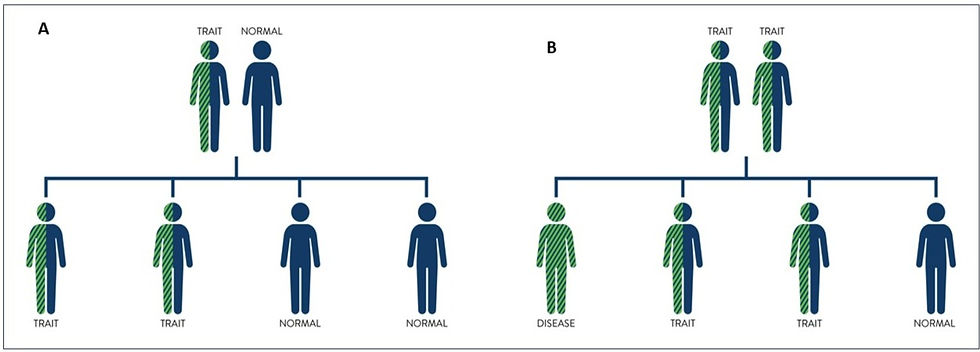
The Sickle Cell Trait occurs when a person carries one normal hemoglobin gene variant and one sickle hemoglobin variant (indicated by green and blue = TRAIT). Individuals with two normal hemoglobin gene variants (blue) are healthy (NORMAL), while those with two sickle hemoglobin gene variants (green) develop sickle cell disease (DISEASE). In (A), when one parent is NORMAL and the other carries the TRAIT, there is a 50% chance that their children will be NORMAL and a 50% chance they will inherit the sickle cell TRAIT. In (B), when both parents carry the TRAIT, their children have a 25% chance of having sickle cell DISEASE, a 50% chance of inheriting the TRAIT, and a 25% chance of being completely healthy (NORMAL). Image credit: Minnesota Department of Health.
Natural Selection at Work
The sickle cell trait offers a classic example of natural selection. In regions where malaria is endemic, individuals with the sickle cell trait have a survival advantage because of their resistance to malaria. As a result, the sickle hemoglobin gene ("HbS" in the image below) is more prevalent in populations from these regions. This is an example of a balanced polymorphism, where the harmful effects of the sickle cell disease (when two sickle hemoglobin genes are present) are balanced by the protective effects of the sickle cell trait (one sickle hemoglobin gene and one normal) against malaria (4).

Image credit: Encyclopædia Britannica, Inc
Genetic Studies and Implications
Genetic studies have provided insights into the distribution of the sickle cell trait and its correlation with malaria prevalence. Understanding this relationship is crucial for public health strategies in malaria-endemic regions and for managing sickle cell disease (5).
Challenges and Future Research
While the sickle cell trait offers protection against malaria, sickle cell disease itself is a serious condition. Ongoing research aims to better understand and treat sickle cell disease while also tackling malaria. Advances in genetics and medicine offer hope for new treatments and strategies to combat both conditions (6).
Summary
The relationship between sickle cell disease and malaria is a powerful example of how human genetics can evolve in response to a disease threat. This evolutionary adaptation highlights the complex interplay between genetics, disease, and environment, offering valuable insights into human biology and disease resistance.
References:
Protection afforded by sickle-cell trait against subtertian malarial infection. British Medical Journal.
Population genetics of malaria resistance in humans. Heredity.
How malaria has affected the human genome and what human genetics can teach us about malaria. American Journal of Human Genetics.
National Heart, Lung, and Blood Institute. Sickle Cell Disease resources for patients.


Comments