
The Chemistry of Multicolored Blood: Exploring Nature's Diverse Palette
- Tommy Aleksander Karlsen
- May 6, 2024
- 2 min read

Blood, the vital fluid circulating in the bodies of many organisms, is often thought of as invariably red. However, the natural world presents a fascinating array of blood colors, each with unique chemical properties and biological functions. This blog post explores the chemistry behind the various colors of blood found in different species, from the common red to the more unusual blue, green, and colorless.
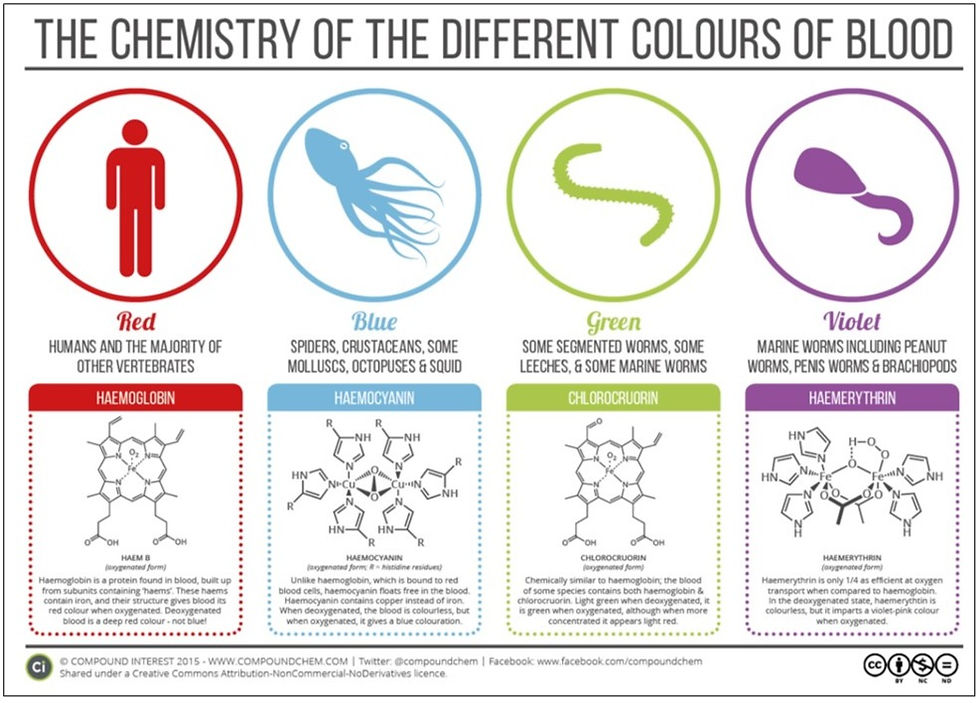
The graphic in this article is licensed under a Creative Commons Attribution-NonCommercial-NoDerivatives 4.0 International License. See the site’s content usage guidelines.
Hemoglobin: The Red Blood of Vertebrates
The red color of blood in humans and most vertebrates is due to hemoglobin, a protein containing iron-bound heme groups. Hemoglobin transports oxygen from the lungs to the body's tissues and facilitates the return of carbon dioxide from tissues to the lungs. The iron in hemoglobin, when bound to oxygen, gives blood its characteristic red color (1).
Hemerythrin: Pink Blood in Some Invertebrates
Hemerythrin is a protein responsible for oxygen transport in the circulatory system of certain invertebrates, including some marine polychaete worms and brachiopods (lamp shells). Unlike hemoglobin, hemerythrin does not contain heme; instead, it binds oxygen directly to iron atoms in its structure, resulting in a pink or violet color when oxygenated (2).
Ice-Fish: The Colorless Blood of Antifreeze
Some species of Antarctic ice-fish (family Channichthyidae) have colorless blood, a unique adaptation among vertebrates. These fish lack both hemoglobin and red blood cells, which is thought to be an adaptation to the high oxygen solubility in the cold Antarctic waters. The absence of red blood cells reduces blood viscosity, allowing for more efficient circulation in the extreme cold (3). See this blog post for more information about the colorless blood of the ice-fish.
Hemocyanin: Blue Blood in Cephalopods and Arthropods
Hemocyanin is a copper-containing protein found in the blood of many mollusks, including cephalopods like octopuses and squids, and some arthropods, such as spiders and crabs. Hemocyanin is colorless when deoxygenated but turns blue upon binding with oxygen, due to the copper ions in its structure (4).
Chlorocruorin: Green Blood in Some Polychaetes
Chlorocruorin is similar in structure to hemoglobin but differs in the composition of its heme group. Found in some polychaete worms, chlorocruorin gives their blood a greenish hue. It is particularly efficient in oxygen transport in low-oxygen environments (5).
Summary
The diversity of blood colors in the animal kingdom is a testament to the adaptability of life on Earth. Each blood pigment has evolved to suit the specific environmental and physiological needs of different organisms, showcasing the intricate relationship between chemistry and biology.
References and further reading
Stereochemistry of cooperative effects in haemoglobin. Nature.
Invertebrate Blood Oxygen Carriers. Comprehensive Physiology.
Antarctic Fish Biology: Evolution in a Unique Environment. Academic Press.
Evolution and function of structurally diverse subunits in the respiratory protein hemocyanin from arthropods. Biological Bulletin.
Nonvertebrate hemoglobins: functions and molecular adaptations. Physiological Reviews.


Comments