
Growing Eyes on the Leg: The Fascinating World of Drosophila Melanogaster and the Pax6 Gene
- Tommy Aleksander Karlsen
- Apr 22, 2024
- 3 min read

In developmental biology, the fruit fly, Drosophila melanogaster, has long been a subject of fascination and study. One of the most intriguing aspects of Drosophila research involves the Pax6 gene, known for its crucial role in eye development. This gene's versatility was dramatically demonstrated in experiments where scientists successfully induced the growth of eyes on the legs of these flies, a groundbreaking discovery that has profound implications for our understanding of genetic control and development.
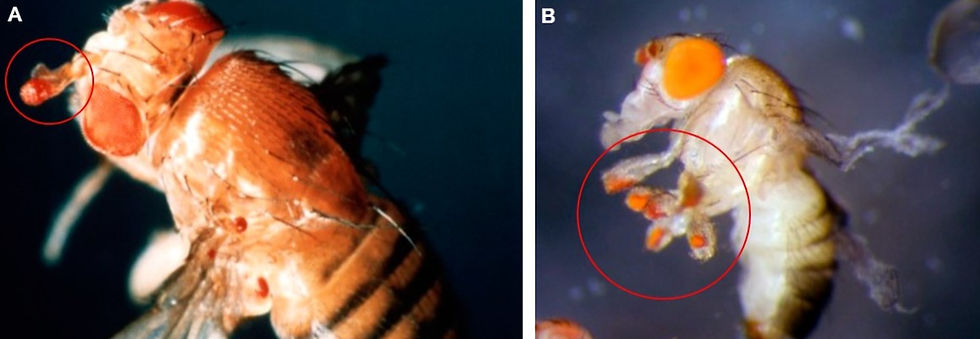
The red dots show development of eyes on the antennae (A) and on the legs (B). Image credit: modified from the paper "Chance and Necessity in Eye Evolution" published in Genome Biology and Evolution.
Understanding the Pax6 Gene
The Pax6 gene is a master control gene that plays a important role in the development of the eyes in animals. It encodes a transcription factor that regulates the expression of other genes, thereby influencing the development of eye structures. The universality of Pax6 in eye development across species is remarkable. From flies to mammals, alterations in this gene can lead to significant eye defects, underscoring its importance in ocular development (1).
The Drosophila Experiment: Eyes on Legs
In a series of groundbreaking experiments, researchers manipulated the expression of the Pax6 gene in Drosophila melanogaster. By activating this gene in non-eye tissues, they were able to induce the formation of ectopic eyes - eyes in abnormal locations, specifically on the legs of these flies (2). This extraordinary feat was not just a demonstration of the gene's power but also a revelation about the deep conservation of genetic mechanisms across species.
Mechanisms Behind Ectopic Eye Development
The development of ectopic eyes in Drosophila involved the ectopic expression of the eyeless gene, a homolog of the Pax6 gene. When activated in leg cells, this gene initiated a cascade of genetic and cellular events, leading to the formation of compound eyes on the legs. These ectopic eyes were structurally similar to normal Drosophila eyes, with lenses, photoreceptor cells, and other essential components, although they were not functional (3).
Implications for Developmental Biology and Genetics
The ability to grow eyes on the legs of Drosophila has profound implications:
Conservation of Genetic Mechanisms: This experiment highlights the deep conservation of developmental mechanisms across different species. The Pax6 gene's role in eye development is conserved from flies to humans, suggesting a common evolutionary origin for eyes.
Regulatory Networks in Development: The study underscores the complexity of genetic regulatory networks. It shows how a single gene can orchestrate the development of a complex organ by regulating a network of other genes.
Potential for Regenerative Medicine: Understanding how the Pax6 gene controls eye development opens possibilities in regenerative medicine, particularly in addressing congenital eye defects and diseases.
Challenges and Ethical Considerations
While the findings are groundbreaking, they also present challenges and ethical considerations, especially when considering similar genetic manipulations in higher organisms. The ethical implications of such genetic control are significant and warrant careful consideration.
Summary
The experiment of growing eyes on the legs of Drosophila melanogaster is a testament to the power of genetic research. It not only provides insights into developmental biology and genetics but also opens new avenues for medical research and applications. As we continue to unravel the mysteries of the genome, the possibilities for understanding and manipulating biological development seem almost limitless.
References and further reading


Comments