
The Mysterious Glow of Fireflies: Unraveling Bioluminescence
- Tommy Aleksander Karlsen
- May 12, 2024
- 2 min read

In the quiet of a summer evening, the glow of fireflies is not just a spectacle but a fascinating biological phenomenon known as bioluminescence. This blog post looks into the science behind the firefly's luminescence, exploring the chemical reactions that create this captivating natural light.
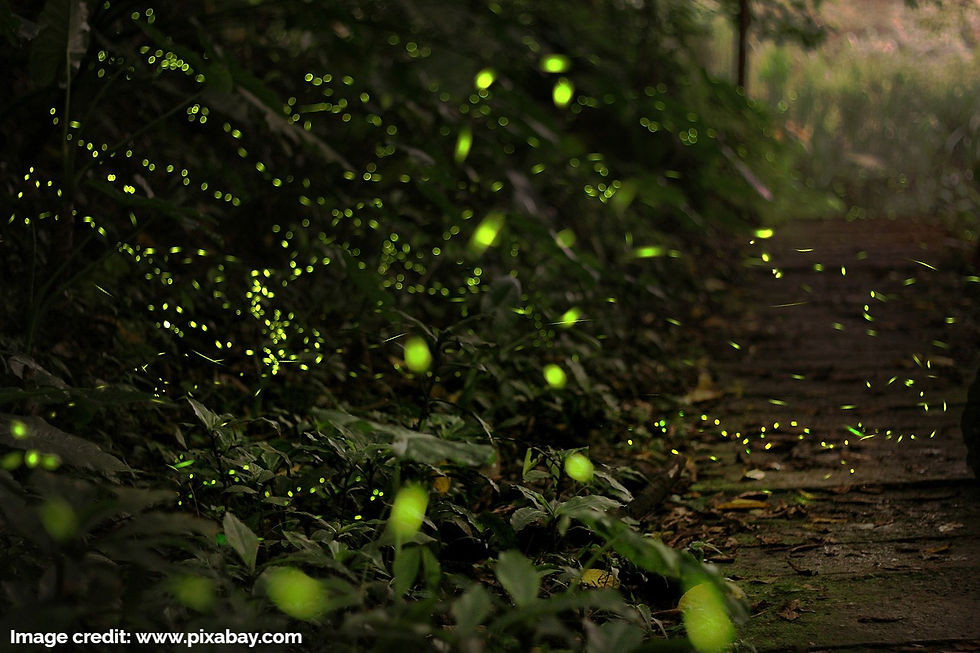
Fireflies can create a magic lightshow.
Bioluminescence: Nature's Own Light Show
Bioluminescence is the production and emission of light by a living organism, a process that occurs in various species, including some fish, fungi, and insects like fireflies. In fireflies, this phenomenon is not just for show; it serves critical functions such as mating communication and predation (1).
The Chemistry of Firefly Light
The light emitted by fireflies is the result of a chemical reaction involving a light-emitting molecule called luciferin and an enzyme called luciferase. When luciferin combines with oxygen, catalyzed by luciferase, it produces light. This reaction, known as the luciferase-luciferin reaction, is highly efficient, resulting in a glow with almost no heat production, making it a "cold light" (2).
Luciferin and Luciferase: The Dynamic Duo
Luciferin is a substrate that, in the presence of oxygen and ATP (adenosine triphosphate), undergoes a transformation when catalyzed by the enzyme luciferase. The reaction produces an excited state intermediate, which, when returns to its ground state, emits light. The color of the light can vary from yellow to green, depending on the species of firefly and the environment in which the reaction occurs (3).

This material is based on content from the Assay Guidance Manual, available under a Creative Commons Attribution-NonCommercial-ShareAlike 3.0 Unported license (CC BY-NC-SA 3.0). Modifications were made for clarity and context. https://www.ncbi.nlm.nih.gov/books/NBK144065/figure/mttassays.F15/.
Regulation of the Light Emission
Fireflies control their light emission through nerve impulses, which regulate the amount of oxygen interacting with the luciferin-luciferase system. This control allows fireflies to produce intermittent flashes of light, which they use for communication, especially during mating rituals. Each species of firefly has a unique flashing pattern, which helps them identify suitable mates (4).
Applications of Firefly Bioluminescence
The study of firefly bioluminescence has led to numerous applications in scientific research. The luciferase enzyme has been used as a reporter gene in molecular biology to monitor gene expression and regulation. It has also been instrumental in medical diagnostics, drug development, and environmental monitoring (5).
Summary
The glow of fireflies is more than just a charming natural occurrence; it's a window into the complex world of biochemical reactions. Understanding the science behind firefly bioluminescence not only satisfies our curiosity about these luminous insects but also opens doors to innovative scientific and medical applications.
References and further reading
Flash signal evolution, mate choice, and predation in fireflies. Annual Review of Entomology.
The colors of firefly bioluminescence: enzyme configuration and species specificity. Proceedings of the National Academy of Sciences.
The origin, diversity, and structure function relationships of insect luciferases. Cellular and Molecular Life Sciences.
Flash signal evolution in Photinus fireflies: Character displacement and signal exploitation in a visual communication system. Evolution. International Journal of Organic Evolution.
A Comprehensive Exploration of Bioluminescence Systems, Mechanisms, and Advanced Assays for Versatile Applications. Biochemistry Reasearch International.


Comments